
When God’s Promise Feels Offensive: 5 Surprising Lessons from Sarah’s Story
Have you ever received a promise from God that sounded almost offensive? Not because the word was evil, but because it felt too good, too impossible, or simply too late. When the Divine speaks a word that contradicts decades of your lived experience, the gap between His promise and your reality can feel like a crushing weight.
WOMEN OF THE BIBLE
2/15/20264 min read
The Pain of the "Too Good" Promise
Have you ever received a promise from God that sounded almost offensive? Not because the word was evil, but because it felt too good, too impossible, or simply too late. When the Divine speaks a word that contradicts decades of your lived experience, the gap between His promise and your reality can feel like a crushing weight.
In the ancient world, Sarah (originally Sarai) did not begin her journey as a hero of faith. She was a woman from Ur of the Chaldeans whose identity was defined by a specific, painful detail: "Now Sarai was barren; she had no child" (Genesis 11:30). This verse serves as a "scar written into the narrative," establishing a history of social shame and biological impossibility.
By the time the promise of a son was reiterated, Sarah was 90 years old. To her, God’s enormous word felt like a mockery of her empty womb and tired heart. Her story is a shocking, deeply human account of how God handles a woman who has waited so long that she no longer expects a miracle.
Takeaway 1: Doubt Often Disguises Itself as Control
When God seems slow to move, many of us fall into the trap of "overfunctioning." We stop waiting on God and start trying to manufacture what only He can give. In Genesis 16, Sarah reached a breaking point and attempted to force an outcome by involving her servant, Hagar.
This was more than a cultural workaround; it was a theological "confession." Sarah explicitly stated, "Behold now, the Lord has prevented me from bearing children" (Genesis 16:2). She interpreted God's delay as a permanent denial and shifted into a mode of human desperation.
Doubt often looks like this frantic need to control every variable and settle for substitutes. Sarah’s attempt to "help" the promise resulted in a home filled with conflict and heartbreak. It serves as a stark reminder that human effort cannot birth a divine promise.
Takeaway 2: Faith is Sometimes Just "Surviving the Delay"
We often demand that faith be loud, confident, and unwavering. However, the Bible does not pretend that Sarah was always certain during her twenty-five-year wait. As the decades passed, her body aged, her hope thinned, and her faith became a messy, complicated struggle.
The power of Sarah’s story is that the Bible includes her in the "Hall of Faith" (Hebrews 11) despite her moments of deep struggle. This suggests that God values the quiet endurance required to keep showing up when the heavens seem silent.
"Faith is not always loud; sometimes faith is simply surviving the delay."
If you’re building a rhythm of Scripture-based reflection (and you want devotionals that make Bible women feel real and relatable), this is a great spot to explore your next read:
“Women of the Bible” book (buy here)
Takeaway 3: God is Unintimidated by Your Cynicism
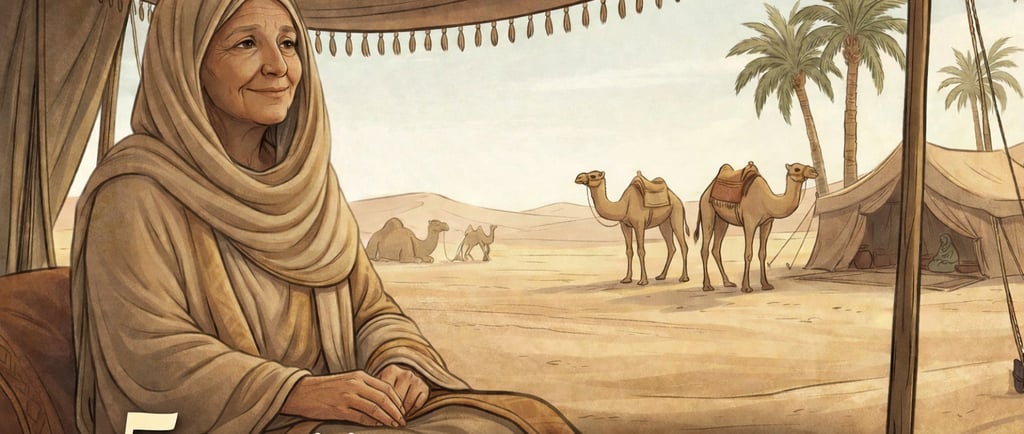
At the oaks of Mamre (Genesis 18), Sarah overheard the Lord promise she would have a son within a year. Her reaction was not a shout of "Amen," but a cynical laugh from behind the tent door. This was "grief speaking"—the reaction of a woman who had been disappointed for far too long.
When God exposed her laughter, it wasn't to condemn her but to bring her doubt into the light. God does not heal what we hide. He responded to her cynicism by reframing her entire world with a question that still challenges every skeptic today:
"Is anything too hard for the Lord?" (Genesis 18:14)
This question forces us to choose our ultimate authority. Is anything too hard for modern medicine, money, or technology? Perhaps. But for Yahweh, the covenant God and the creator of the womb, the word "impossible" does not exist.
Takeaway 4: Your Perfection is Not a Prerequisite for God’s Faithfulness
The miracle finally arrived in Genesis 21, and the text is meticulously clear about why it happened. It says the Lord visited Sarah "as He had said" and did for her "as He had promised. "The fulfillment was rooted entirely in God’s character, not in Sarah’s flawless behavior.
This is a counterintuitive take on blessing: God’s faithfulness is tied to His covenant, not our performance. Even when Sarah was past the age of childbearing, Hebrews 11:11 notes she received power because she eventually shifted her focus to "consider Him faithful who had promised."
God does not erase the messy parts of our story; He redeems them. He took a woman who laughed in disbelief and placed her in the Hall of Faith, proving that His grace is larger than our greatest moments of doubt.
Takeaway 5: God Specializes in Redeeming "The Laugh"
There is a profound irony in the naming of Sarah’s son. They named him Isaac, which means "he laughs." God took the very sound of Sarah’s cynicism and transformed it into a permanent testimony of joy. He named her Miracle after her struggle.
"God has made laughter for me; everyone who hears will laugh over me." (Genesis 21:6)
This is the ultimate goal of God’s timing: He doesn't just fulfill the promise; He redeems the memory of the delay. He turned Sarah's "laugh of pain" into a "laugh of praise," ensuring that every time she called her son's name, she was reminded of God's victory over her skepticism.
Conclusion: A Promise for the Tired Heart
Sarah’s journey proves that God specializes in impossible timelines. He is not threatened by your honest, weary reactions, nor is He limited by your past mistakes or biological "dead ends." He is the God who stays even when we laugh in His face.
If you are in a season where your heart is laughing out of exhaustion rather than joy, remember that God is still at work behind the tent door. What would change in your life today if you truly believed that nothing is too hard for the Lord? Trust that the same God who saw Sarah is still able to turn your "impossible" into an "Isaac."
Connect
Join our community for daily spiritual growth.
Contact
Subscribe
© 2026. All rights reserved.