
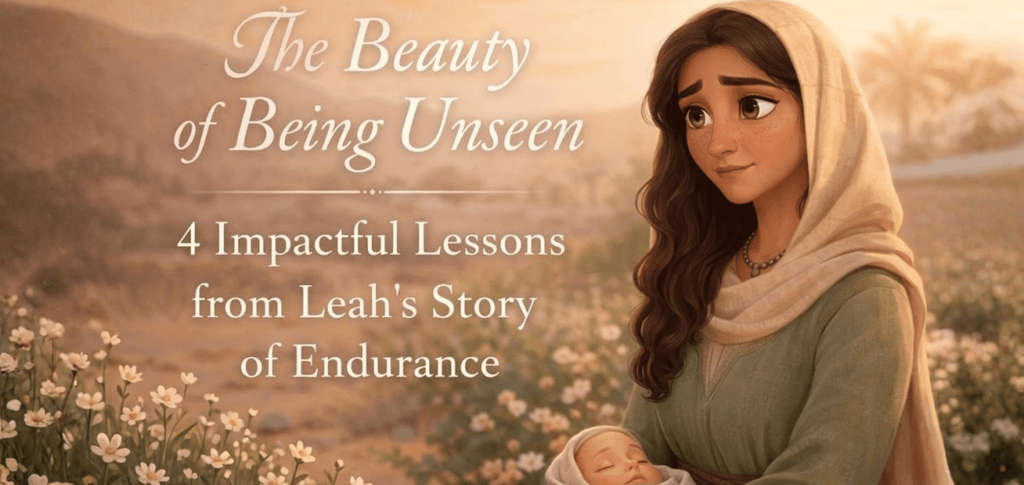
The Beauty of Being Unseen: 4 Impactful Lessons from Leah’s Story of Endurance
There is a specific, quiet weight that comes from living in the periphery of visibility. It is the experience of being the reliable presence in the background while others are celebrated in the foreground, the ache of being "second best." This feeling of being overlooked isn't just a social inconvenience; it is a deep-seated narrative of the heart that many women carry into their careers, their families, and their quietest moments. In the sovereign architecture of faith, few women offer more profound resonance for this experience than Leah. Positioned within the "Mothers and Matriarchs" of the biblical narrative, Leah is defined in the ancient records as a woman of "devotion and endurance." Her story is a sophisticated exploration of how one moves from the sting of being humanly unloved to the quiet power of being divinely recognized.
3/10/20263 min read

1. God Sees the Overlooked (The External Reality)
Leah stands as a primary witness to a truth that is as revolutionary today as it was in antiquity: she was a woman overlooked by human gaze yet held firmly in the sight of God. While the structures of her world, and the dynamics of her own home, prioritized those who were "chosen" by human standard or physical favor, God was meticulously attentive to her.
Her narrative reminds us that visibility is not a prerequisite for value. In a modern culture where our worth is often treated as a commodity traded for likes, accolades, or the "chosen" status within our social circles, Leah’s presence in the text offers a radical redirection.
"God sees and values the overlooked (like Hagar, Leah, and Rizpah)."
To be "seen" by the Creator is a fixed reality that exists independently of our social standing. For the woman who feels she is living in a permanent shadow, Leah’s story asserts that the most important Gaze in the universe is already fixed upon you with intentionality.
2. The Strength Found in Endurance
The narrative of a Matriarch like Leah is rarely a story of an "overnight breakthrough." Instead, it is a "journey through endurance." Within the structure of a spiritual walk, much like the 30-day rhythm of a focused devotional, we see that faithfulness is often forged in the long, unglamorous middle of a difficult situation.
Endurance, as embodied by Leah, is not a passive "putting up" with circumstances. It is a proactive "walking in faith," as we find our place within a broader "chorus of wisdom." It is the steady persistence of a woman who remains devoted to her path even when the human rewards are absent.
"May their extraordinary faith inspire your own."
This brand of endurance is a quiet brilliance. It is the "extraordinary faith" that persists through the ordinary, often wearying details of a life that feels uncompensated. Leah teaches us that staying power is, in itself, a form of spiritual mastery.
If you want guided, Scripture-based reflections you can actually finish (and share), see the “Women of the Bible” book (buy here)
3. Shifting from Man’s Approval to God’s Love (The Internal Work)
If the first lesson of Leah is about God’s external gaze, the third is about our internal response. Leah is documented as a woman who eventually "found blessing in God’s love, not man’s."
This represents a sophisticated psychological and spiritual pivot. Most of us spend the better part of our lives tethered to the hope that a specific person—a partner, a parent, a peer—will finally offer the validation we crave. Leah’s life shows us the exhaustion of that pursuit and the liberation that occurs when we sever that tether.
As you Pause and Reflect on your own narrative, consider the "Inner Work" required to identify where you are still bartering your peace for human approval. The blessing Leah found was not a change in her husband's affection, but a transformation in her own source of contentment. She shifted her internal posture from seeking to be "chosen" by man to being fully satisfied in being "known" by God.
4. The Extraordinary Impact of a "Forgotten" Life
We often mistake "quiet" for "insignificant." However, the legacy of Leah proves that God "redeems broken stories for His purposes." While she may have felt like a background character in the drama of her own life, she was an essential architecture in the unfolding of a global purpose.
God works through every life—whether that life is categorized as "faithful, broken, bold or forgotten." Leah may have been overlooked in the immediate context of her household, but she was never forgotten in the intentional design of the Divine.
"God works through every life, whether faithful, broken, bold or forgotten."
Her life is a testament to the fact that your current "unseen" status is not a disqualification. In the economy of God, the "broken" and the "overlooked" are often the very instruments used to carry the weight of a lasting legacy.
Conclusion: From Unseen to Found
The journey of Leah is a transition from the periphery to the center of God’s love. She invites us to recognize that being "unseen" by the world can be a sacred, protected space where we are most authentically found by the One who matters most.
As a practical application of this wisdom, identify one area of your life where you feel most unappreciated or invisible. Rather than exerting more energy to be "noticed" by those around you, surrender that area to the "God who sees." Trust that He is working through your endurance and that He values your devotion more than any human accolade.
If you were fully convinced that the Creator of the universe saw your every struggle, whose approval would you finally be brave enough to stop chasing?
If you want guided, Scripture-based reflections you can actually finish (and share), see the “Women of the Bible” book (buy here)
Connect
Join our community for daily spiritual growth.
Contact
Subscribe
© 2026. All rights reserved.