
Is Anything Too Hard? 5 Surprising Ways Sarah’s Faith Beats Modern Doubt
In our contemporary era, we are often defined by a pervasive cynicism. We live by the rigid tyranny of the calendar, the finality of biological clocks, and the harsh, empirical data of "the possible." When a hope is delayed long enough, we do not merely label it a disappointment; we categorize it as a closed door. We understand the suffocating silence of a tent where a promise has sat unfulfilled for decades.
WOMEN OF THE BIBLE
2/7/20264 min read
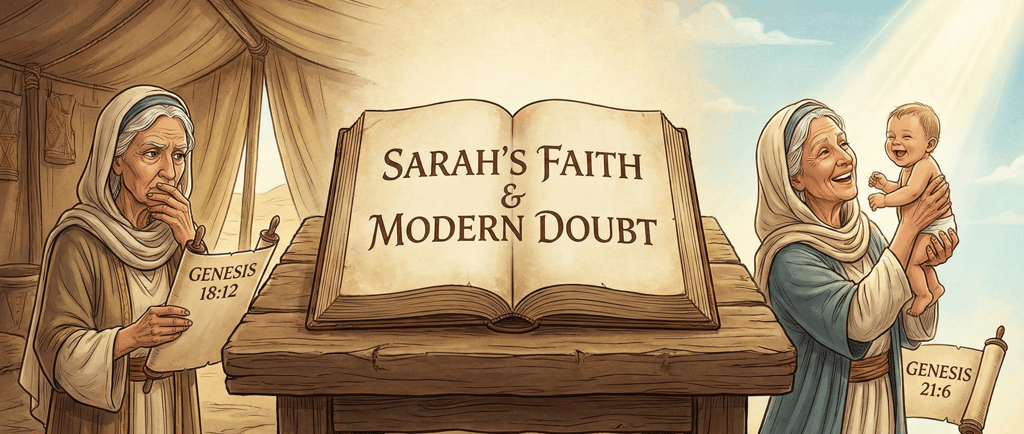
Sarah (initially Sarai) is the archetypal figure for this tension. Her narrative begins with a definitive, bleak observation that serves as a literary dead end: "Now Sarai was barren; she had no children" (Genesis 11:30). In the Hebrew tradition, such a statement isn't just a medical diagnosis; it’s a statement of identity. She lived in the agonizing space between a grand divine promise and a physiological reality that screamed "impossible." Yet, Sarah’s journey provides a sophisticated roadmap for the modern doubter, showing how one moves from the laughter of skepticism to the laughter of true fulfillment.
1. The "Too Late" Fallacy: Faith Beyond the Biological Clock
Modern doubt is frequently a matter of the calendar. We believe that if a breakthrough hasn’t occurred by a certain age or career stage, the "expiration date" on God’s power has passed. Sarah faced the ultimate expiration date. She was ninety years old when the final announcement of a son’s birth was delivered (Genesis 17:17), while Abraham was one hundred.
The text is unflinching about the biological reality, and as scholars note, the narrative intentionally emphasizes the human impossibility to highlight the divine prerogative. The writer of Genesis leaves no room for a "natural" explanation:
Abraham and Sarah were already old and well advanced in years, and Sarah was past the age of childbearing. (Genesis 18:11)
Sarah’s story teaches us that divine timing does not operate on human biological or social schedules. While Genesis 11:30 establishes her barrenness as a fixed fact of her youth, Genesis 21:2 records the eventual reality: "Sarah became pregnant and bore a son to Abraham in his old age, at the very time God had promised him." Her life suggests that "too late" is a human fallacy, not a divine limit. The biological fact was recognized by God—He did not ignore her age; He simply wasn't restricted by it.
2. Honest Skepticism: The Gritty Reality of Divine Confrontation
There is a common misconception that faith must be a monolith of perfect, unwavering certainty. Sarah’s faith was far more "gritty" and human. When she heard the prophecy from the visitor behind the tent flap, she "laughed to herself" (Genesis 18:12). This wasn't a public scoff; it was an internal, private struggle—a reflex of a mind that had been protected by cynicism for too long.
From a scholarly perspective, it is vital to notice that Sarah’s skepticism did not disqualify her. Her doubt led to a remarkably direct and intimate confrontation with the Divine. When she lied out of fear, claiming, "I did not laugh," the Lord did not offer a polite platitude. He countered with a staggering, direct honesty: "Yes, you did laugh" (Genesis 18:15).
This divine-human friction shows that God is not offended by our honest realization of human limits. In the midst of her doubt, He offered the rhetorical anchor that defines her entire theology:
"Is anything too hard for the Lord?" (Genesis 18:14).
If you want guided, Scripture-based reflections you can actually finish (and share), see the “Women of the Bible” book (buy here)
3. The Sovereignty Crisis: Bypassing the "Help God Out" Trap
When the divine timeline seems stalled, the human instinct is to "hustle"—to take control and force an outcome. Sarai fell into this trap when she decided to "build a family" through her Egyptian maidservant, Hagar. It is a detail of significant scholarly weight that Sarai waited until she had been in Canaan ten years (Genesis 16:3) before she took matters into her own hands. Her patience was not thin; it was simply exhausted.
This attempt at self-reliance resulted in immediate misery that went beyond simple regret. The text records a total breakdown of the household structure: Hagar began to "despise her mistress," leading to a cycle of mistreatment and domestic bitterness (Genesis 16:4-6). In the ancient Near Eastern context, this was a devastating loss of social status and peace. This incident reflects a profound truth: when we try to manufacture a divine promise through human manipulation, we often create more misery than the original waiting caused. Sarah’s eventual faith was rebuilt not through her success in controlling the situation, but after her own plans had failed.
4. A New Identity: The Significance of the Renaming
One of the most transformative moments in Sarah’s journey occurred before the physical miracle took place. It was a total household re-identification. Just as Abram was renamed Abraham ("father of many"), God declared that Sarai would now be Sarah (Genesis 17:5, 15).
In the nuanced shift of the Hebrew names, "Sarai" (often associated with a more possessive or tribal "my princess") became "Sarah"—the noble, universal "Princess" and "mother of nations" (Genesis 17:16). At the moment of this pronouncement, she was still ninety and her womb was still empty. This suggests that in the biblical perspective, identity is defined by God’s promise rather than current circumstances. Modern doubt is often an identity crisis, but Sarah’s story posits that God sees the queen even when the woman in the tent feels like a failure.
5. The Final Laugh: From Cynicism to Mandated Joy
The trajectory of Sarah’s life is traced through two different types of laughter. The first was the laughter of the skeptic (Genesis 18:12); the second was the laughter of the mother. Upon the birth of her son, the irony of her journey was made permanent through the child’s name.
It is crucial to recognize that the naming of Isaac—which means "he laughs"—was not a parental whim but a divine mandate given by God in Genesis 17:19. The name served as a perpetual memorial to God’s sense of humor over human impossibility. The cynicism that once protected Sarah’s heart was replaced by a joy so expansive it required witnesses.
"God has brought me laughter, and everyone who hears about this will laugh with me." (Genesis 21:6)
Conclusion: Pondering the Impossible
Sarah’s journey reveals that faith is not the absence of doubt, but the persistence through it. Her story encompasses the biological "impossibility" of her age, the honest skepticism of her heart, the failure of her attempts to control the outcome, and the eventual transformation of her identity.
She stands as a witness that "barren" areas of life are not necessarily dead ends; they may simply be the stages upon which the "too hard" becomes a reality.
In a world of limits, what would change if you lived as if nothing were too hard for the Lord?
If you want guided, Scripture-based reflections you can actually finish (and share), see the “Women of the Bible” book (buy here)
Connect
Join our community for daily spiritual growth.
Contact
Subscribe
© 2026. All rights reserved.